A lifeless image
A few days ago, I went to the cinema to watch Princess Mononoke. I hadn’t seen it in years, and I went because an upgraded version with better sound and video was being shown. Those days reminded me of when I first saw it in my teens, back when my family owned a video store and I was downloading and watching anime that I later shared with my friends. I loved watching it again and reconnecting with those years when I discovered animation and developed my love for illustration and graphic arts in general. I would say that during that time, I started to consider drawing, and eventually design, as something I could pursue for the rest of my life.
One thing I really love about Studio Ghibli films is the soundtrack. Every now and then, I listen to a Joe Hisaishi album or a piano performance of the main songs. This concert, performed a couple of years ago, celebrating his 25th anniversary as the main composer is very touching.
I also went to see the film because of all the buzz on social media about OpenAI’s new model and the ability to generate images in the animation studio’s style. I wanted to experience again what I loved so much about Miyazaki’s films. With the Ghibli-style images flooding, I was thinking a lot about the relationship between art and technology, and the impact that the ease of instantly generating high-quality illustrations has on people’s perceptions.

A storybook frame with notes in Japanese.
The film was, of course, better than I remembered. The concept of good and evil is central to the story and has multiple angles on how nature and humans can be both cruel and kind at the same time. The soundtrack is beautiful and, as expected, every scene is thoroughly edited to shape dramatic moments of magical realism. Nothing is left to chance.
In the studio’s distinctive style, where most animation is done by hand, removing a frame from the story’s context and presenting it as something worthy by itself strips away all meaningful traits. The image becomes nothing more than a snapshot of a scene captured with a specific illustration style. Unfortunately, that’s the only value this image-generative tool offers. Take a photograph and apply an “anime-style” filter. No more, no less.
Communicating an idea through an image requires thinking of a form and then executing it, to then thinking and executing it again. And extend this process over time until the image gains enough force to communicate itself. So much energy is invested in this process that “De vuelta con el cuaderno” arranges a workshop for participants to think and immerse themselves in the endless possibilities of a drawing notebook.

Storyboard snaps of the movie.

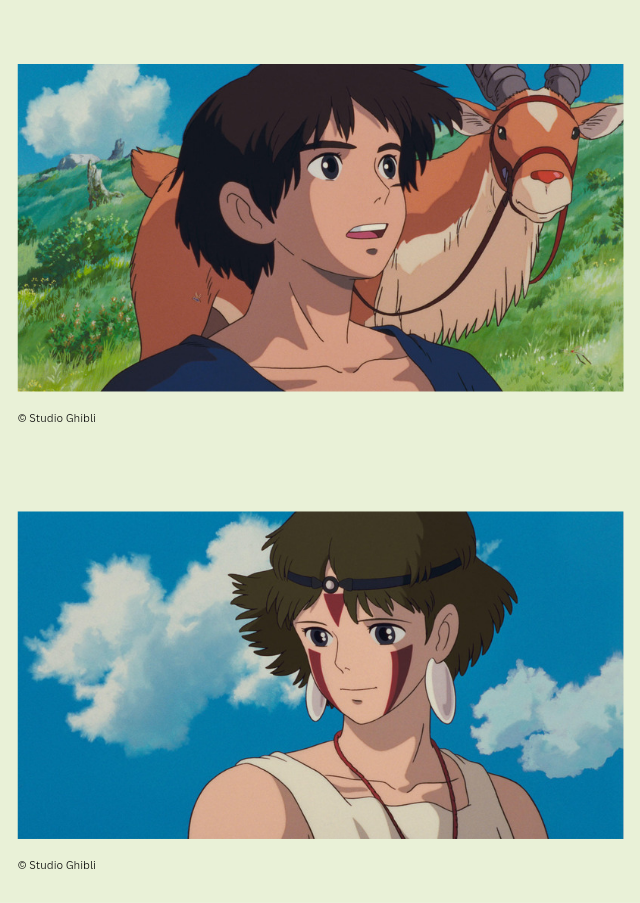
Before and after. From storybook to frames.
An automatic tool that takes a photograph and redraws the elements in a specific style results in an image that lacks meaning. Why invest time, and so much energy, in building a tool that barely scratches the surface of an illustration style? And by the way, why do they all have that orangey-brown tint?
But at the same time, blaming those who use these tools and accusing them of committing an insult is also overreacting. Studio Ghibli doesn’t own an illustration style, despite becoming the most iconic studio in Japanese animation. If I want to see a photo of my family in an anime style, I don’t see anything offensive in applying an image filter. I have the feeling that most people just want a pretty picture for their WhatsApp profile, not to start a lucrative image-selling business. Although there are surely some fools out there doing it.
The way OpenAI trains and uses its models is offensive, but that’s a different topic.
I also don’t think Miyazaki is exaggerating when, years ago, before the artificial intelligence boom, he told some students that the test they made with a generative model was an “insult to life.” The students were selling optimization to an animation studio that takes a year and a half to produce a 4-second scene. Producing more in less time isn’t exactly what Miyazaki was aiming for.
Below you can see the full moment when Miyazaki is stunned by what he’s seeing. Audio in Japanese with English subtitles.
From that same recording, I believe there are some words before the famous quote that are much more revealing and point to the idea of a meaningful image.
Every morning… not recent days, but I see my friend who has a disability. It’s so hard for him just to do a high five, his arm with stiff muscle reaching out to my hand. Now, thinking of him, I can’t watch this stuff and find interesting. Whoever Creates this stuff has ho idea what pain is or whatsoever. I’m utterly disgusted. If you really want to make creepy stuff, you can go ahead and do it. I would never wish to incorporate this technology into my work at all. I strongly feel that this is an insult to life itself.
To portray suffering, you must be close to it.
I don’t think that generating Studio Ghibli-style images is the end of the world. Fortunately, the boom has passed and is now in the archives of social media trends. But it is sad to see a dehumanizing technology that reduces human expression to a simple logic of effective production.